Classical bots & AI orchestration
Initial experiments connected traditional software bots with emerging AI tools, extending established automation through LLM capabilities.
Personal research project · November 2026. The agent execution layer runs locally; fully self-hosted inference remains work in progress. A distilled public source release of AI-System-7 is planned.
The seventh iteration of a personal AI infrastructure project, exploring a universal agent core, task-specific specialization and owner-controlled execution. A local Ubuntu agent layer uses the Xiaomi MiMo ecosystem while self-hosted inference and reduced dependence on remote services remain active research goals.
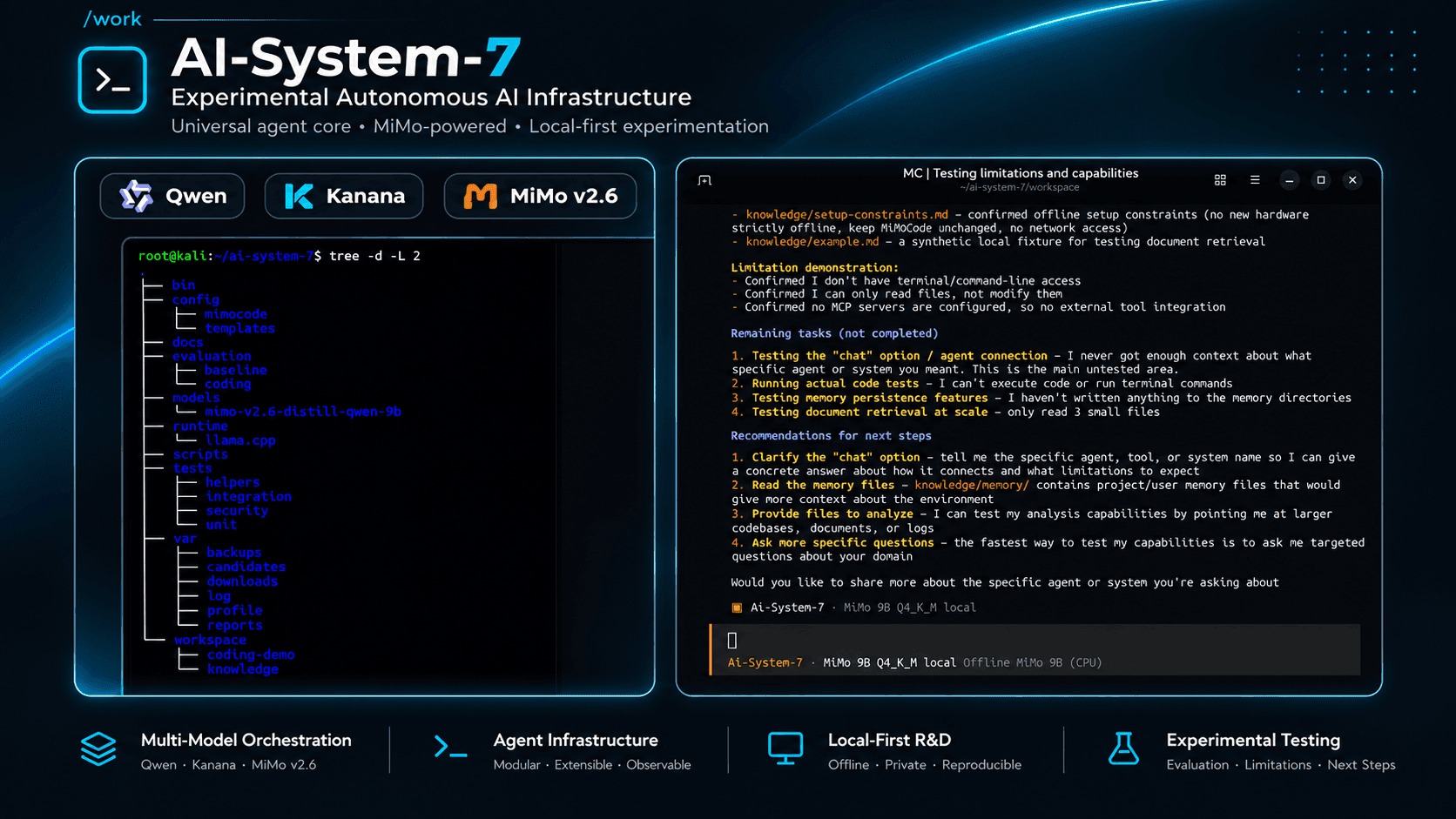
Role · System architecture, agent runtime integration and infrastructure experimentation
Move beyond predefined automation toward an agent that can analyze a task, plan its next actions and use appropriate tools across different kinds of work. Keep that autonomy compatible with explicit permissions, supervised execution and control over critical infrastructure.
Build around a universal agent core, with modular tools and specialized instances rather than a fixed hierarchy for every workflow. Keep persistent state, authorization and execution verification separate from the model, and develop the inference infrastructure toward greater owner control.
AI-System-7 is the seventh iteration of my personal experiment in building agents for practical work beyond chat and coding assistance. The objective is an environment where an agent can analyze an assigned task, plan actions, use tools and adapt to different types of work.
A universal agent should also provide a foundation for specialized instances. Those instances can be configured for particular tasks, equipped with the appropriate tools and, where useful, developed through further training. These are directions for the system, not a claim that every capability is complete.
Autonomy must remain compatible with control: defined permissions, supervised execution and independence of critical infrastructure.
The author-supplied cover presents the experimental setup and a session discussing its limitations. It is a project overview, not a benchmark or proof that all tools and integrations run offline.
The project began with automating existing software tools. Over successive iterations, the focus moved toward agents that could determine how to approach a problem rather than follow a predefined sequence.
Initial experiments connected traditional software bots with emerging AI tools, extending established automation through LLM capabilities.
Simple agents began interpreting tasks, selecting tools and executing sequences of actions with less dependence on rigid workflows.
I explored an architecture in which the language model became the central decision-making component rather than only a request processor.
Multi-agent experiments introduced specialized roles, persistent state, tool interfaces and controls over autonomous execution.
The focus shifted toward a strong general-purpose model as the foundation for agent execution across different kinds of tasks.
I experimented with an alternative model family, its architecture and its potential role in specialized intelligent systems.
MiMo-V2.6-Distill-Qwen-9B became the primary experimental model for agentic workflows, programming, tool use and practical problem-solving.
After the fourth iteration, my next objective became clearer: find a sufficiently capable general foundation rather than continually add complexity to the orchestration of individual agents. Qwen, Kanana and MiMo became successive experiments in that direction.
The most interesting result so far has been the opportunity to simplify parts of the earlier OpenClaw workflows and place more of the planning and tool-use decisions in the model. The execution infrastructure still matters; it is not replaced by a stronger LLM.
These observations come from my personal experiments. They are not standardized comparative benchmark results.
The seventh iteration centers on the Xiaomi MiMo ecosystem and a universal agent core, surrounded by tools, workflows and specialized capabilities. Six layers describe the architecture and its direction.
MiMo-V2.6-Distill-Qwen-9B is the experimental intelligence foundation. The model is responsible for interpreting objectives, reasoning about tasks and choosing next actions.
A local execution layer manages the cycle of receiving objectives, planning, invoking available tools and processing results. The aim is to rely more on model-led decisions and less on manually defined paths for every task.
The wider ecosystem includes models, APIs and agent solutions such as MiMo Code and MiMo Claw. MiMo Claw is a separate cloud service built on OpenClaw; it is neither the language model itself nor evidence of a fully local runtime.
Development tools, search, analytics, automation and external integrations can extend the core. Specialized instances are a way to adapt the same foundation to particular tasks without rebuilding the architecture each time.
Decision-making, persistent results, authorization and verification of actual execution remain separate concerns. These functions need to stay manageable when the underlying model changes.
The current design combines local agent execution with access to external computing resources. Fully self-hosted MiMo inference is an important next step toward reducing latency and dependence on providers.
The direction is a core that can expand through specialization, additional instances and new tools, rather than a fixed hierarchy of agents for every workflow.
AI-System-7 is running in my local Ubuntu Linux environment. The agent execution layer and basic integration with the model and tools are operational. My attention is shifting from organizing agent logic toward inference infrastructure and the quality of interaction with the LLM.
Develop inference where model weights, computation and execution remain under the owner's control, without mandatory reliance on a cloud API.
Reduce delays when communicating with remote servers and improve responsiveness across agent workflows.
Further work includes inference efficiency, agent specialization, training mechanisms and evaluation. Full production readiness and comprehensive reproducible test results are not yet claimed.
The question is no longer only which model is most capable. New models, runtimes, tools and inference techniques keep changing the available choices. Long-term infrastructure needs to accommodate those changes.
Models must be interchangeable. Tools must be modular. Execution must be auditable. Permissions must be technically enforceable and controlled. State must remain portable, and infrastructure must be able to continue when individual components are replaced or become unavailable. These principles guide the work.
Model autonomy and infrastructure independence are separate challenges. An intelligent agent still depends on external decisions when its owner does not control the computation, data or conditions under which it operates. Self-hosted models are therefore an architectural goal for me, not only a way to reduce inference costs.
Agent autonomy without infrastructure autonomy is not autonomy.
User-controlled. Private by design. Independent by architecture.
A locally running Ubuntu agent prototype with basic model and tool integration. Current work focuses on self-hosted MiMo inference, network latency, specialization and evaluation. Production readiness and comprehensive reproducible test results are not yet claimed.
A distilled public edition of AI-System-7 is planned. The GitHub link is the intended location for that release; the source is being prepared for publication.
Developed by Alexey Smirnoff · November 2026.