ai-system-4
A personal AI system, distilled for public review.
Personal project built on OpenClaw. The GitHub repository is a distilled, sanitized edition of an earlier prototype. Images span project versions; dashboard counters are not independently verified outcome metrics.
The distilled public edition of a personal AI workflow system built on OpenClaw. Ten specialized agent roles share a task registry and scoped tools for research, job application preparation, mail review and security analysis, with explicit human approval for external submission.
Role · System architecture, workflow engineering, MCP integration and local dashboard development
Give multi-agent work a consistent structure. Tasks need a responsible role, a visible state and evidence that can be reviewed. Research, drafts and uncertain outcomes need to remain distinguishable from completed actions.
Build an application layer around OpenClaw: a shared SQLite task registry, fixed role-specific MCP tools, versioned workflow records and local dashboards. Keep consequential actions behind separate approval and preserve unknown outcomes rather than treating a model response as proof of completion.
Make the state of the work understandable.
I built ai-system-4 as a personal experiment in coordinating research, career preparation, mail review and security analysis. It started on early OpenClaw betas under Windows, migrated to Ubuntu, and continued to evolve as I worked with it. The GitHub edition distills that earlier system into a smaller core for public review.
OpenClaw supplies the Gateway, model-provider connections and native sessions. My application layer adds task contracts, role-specific MCP tools, workflow state, approval records and local interfaces. Ten specialized roles provide a way to assign responsibility while the shared registry records tasks, results and evidence.
Designed & built
- Task registry and bounded role contracts
- Role-scoped MCP tools and input validation
- Career research and application preparation workflows
- Personal Operations and Career Control interfaces
- Versioned improvement proposals and review controls
Integrated & configured
- OpenClaw Gateway, providers and agent sessions
- Read-only Outlook mail review
- Greenhouse, Lever and Ashby job sources
- Passive Ubuntu and local website security reports
- Ubuntu launchers and user-service templates
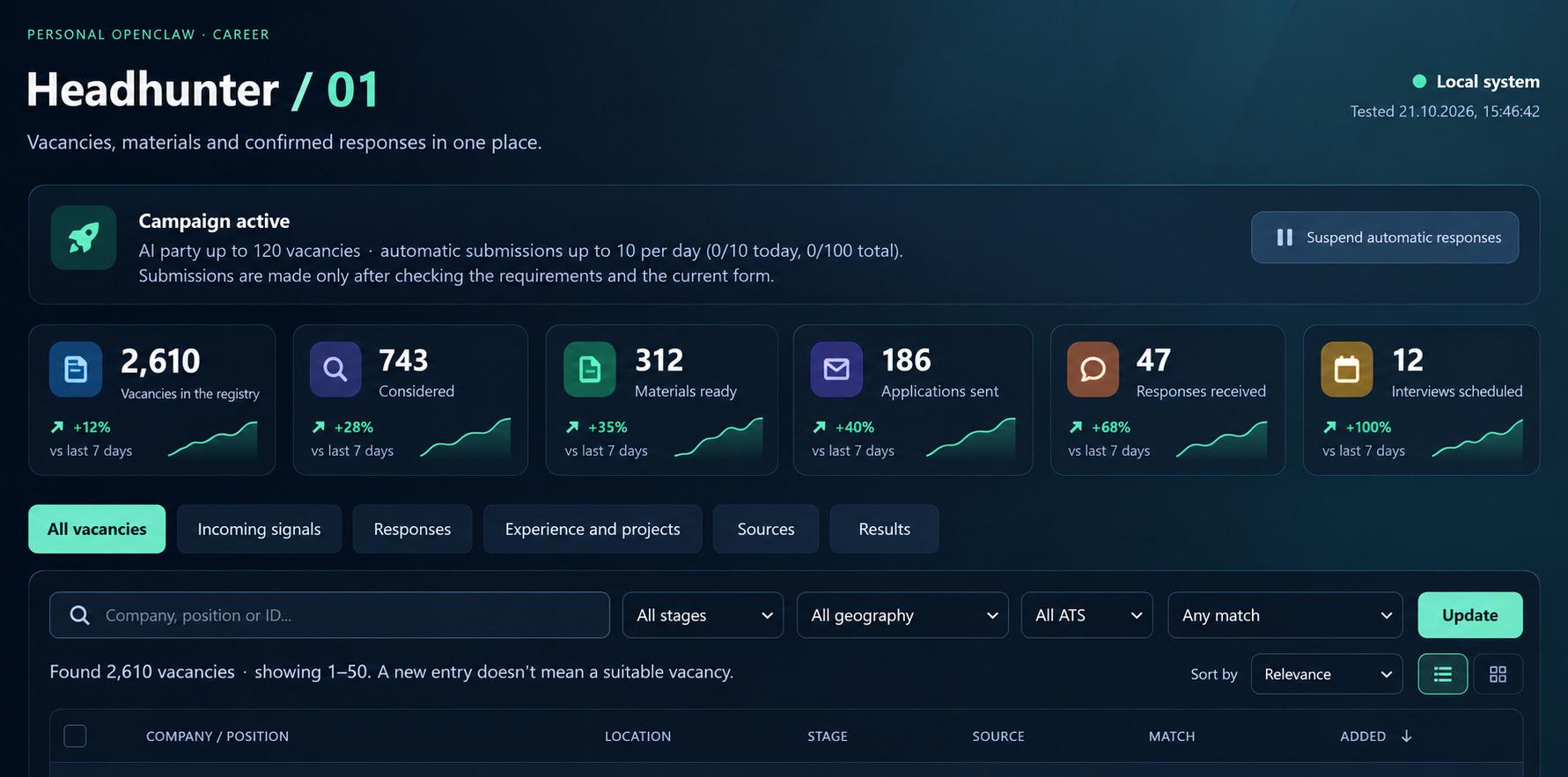
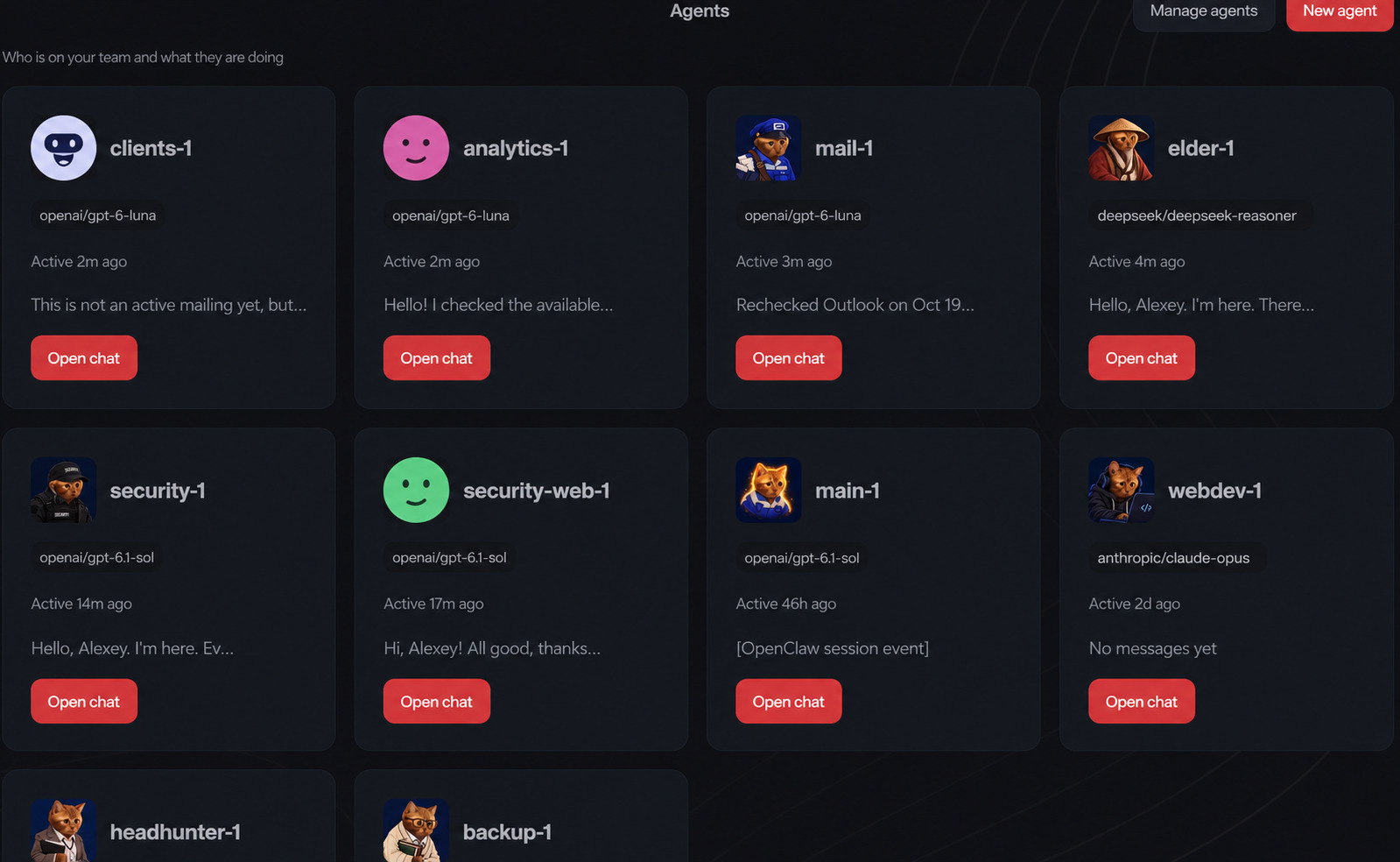
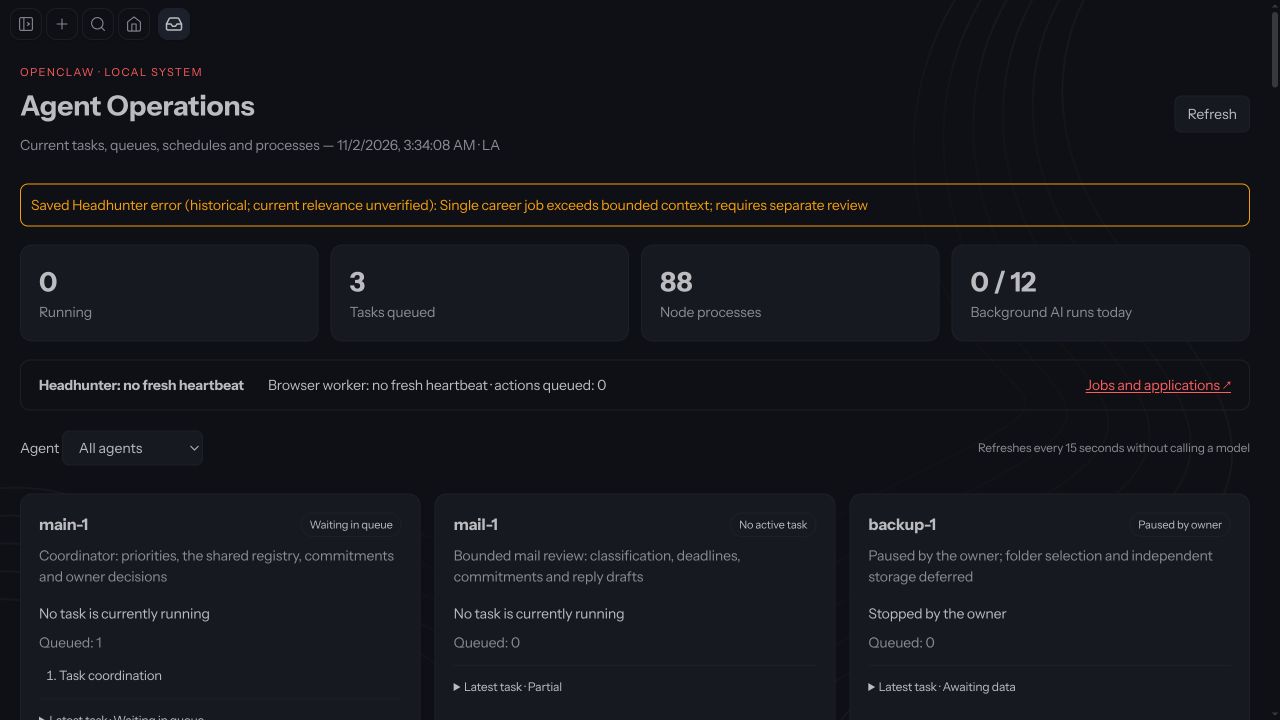
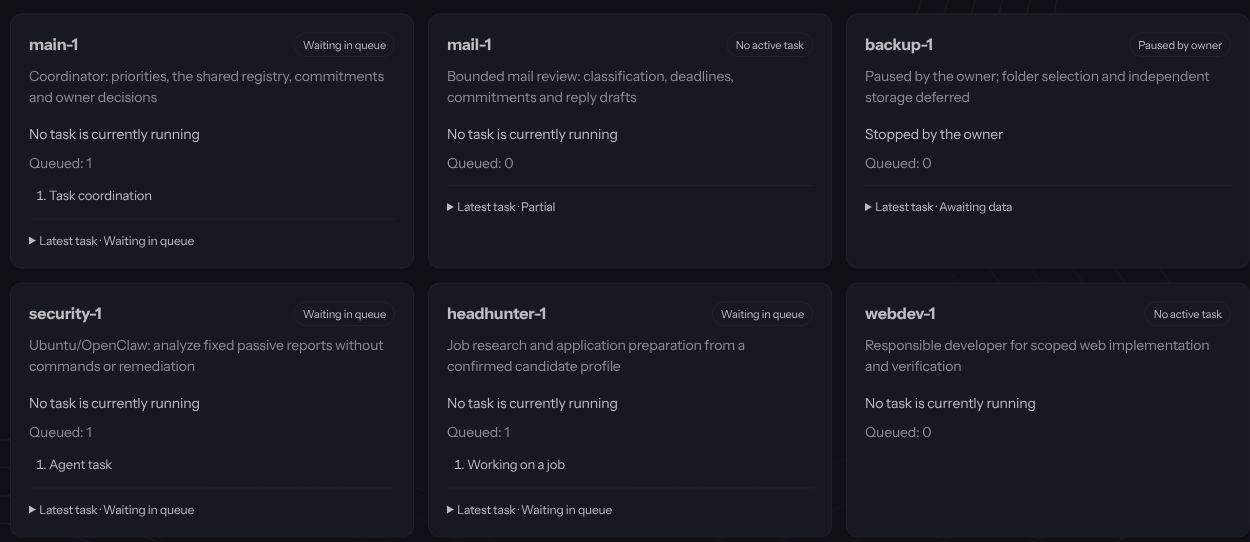
The cover and agent/model overview were supplied by the author. The job-detail view is from October 2026; the remaining local screenshots were captured on November 2, 2026. They show different versions and retained state. Campaign labels, counters and charts are interface content, not independently verified application or interview outcomes.
See responsibilities alongside task states.
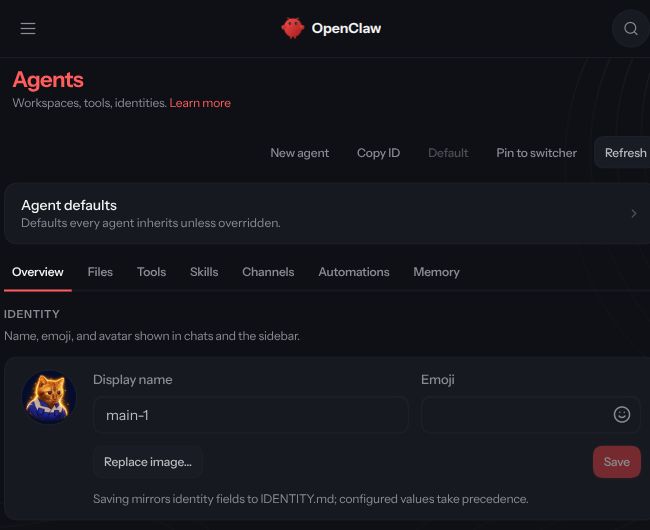
The overview brings roles, queues and runtime observations into one place. Each role has a defined responsibility, while task states distinguish waiting work, partial results and missing information. A configured role or a queued task is not evidence that a worker is running.
Keep discovery, preparation and submission separate.
Career Control is a read-only dashboard over the career registry. It makes source records, job filters and preparation stages available for review without turning every discovered vacancy into an application.
The workflow moves from source research and requirements review to candidate facts and a versioned application package. Submission needs separate owner approval tied to the exact package, source and profile versions. CAPTCHA steps require manual handoff.
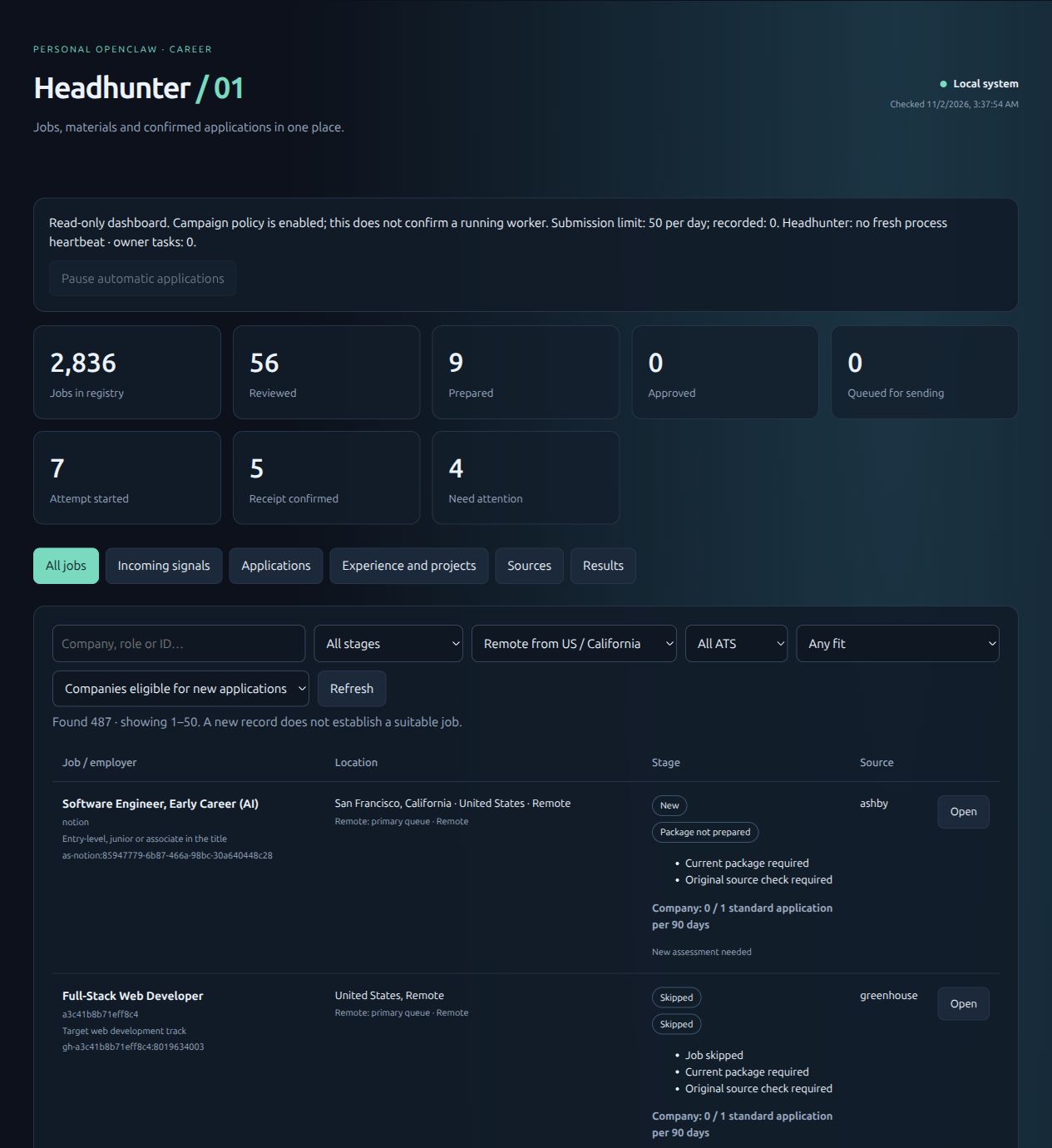
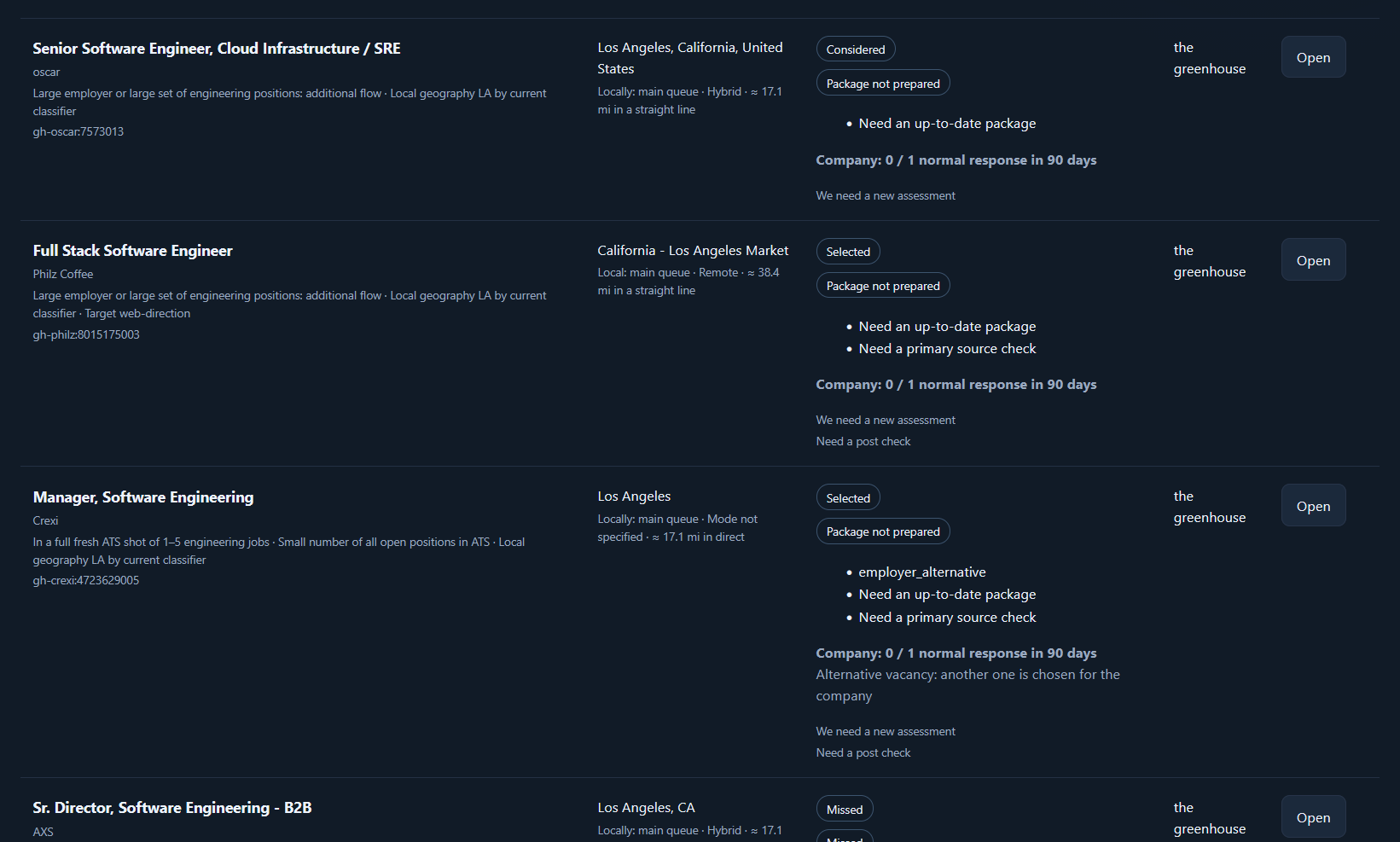
At the individual record level, a selected role can still need an up-to-date package, a fresh assessment or a check of the original source. Those requirements stay visible before any submission is considered.
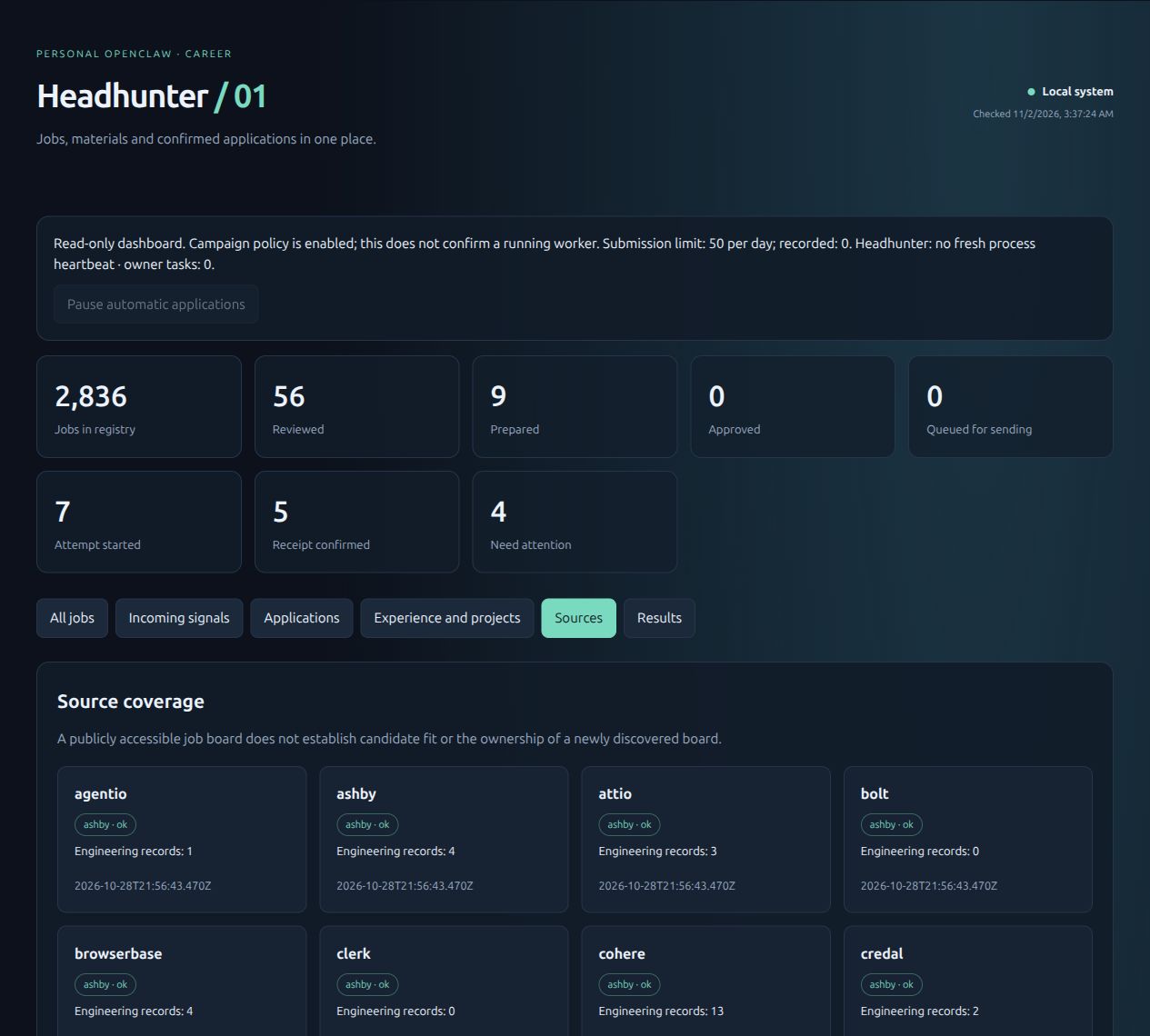
Source coverage has its own view. A collected job-board record does not establish candidate fit, and a saved package does not grant permission to send.
Define what each role can do.
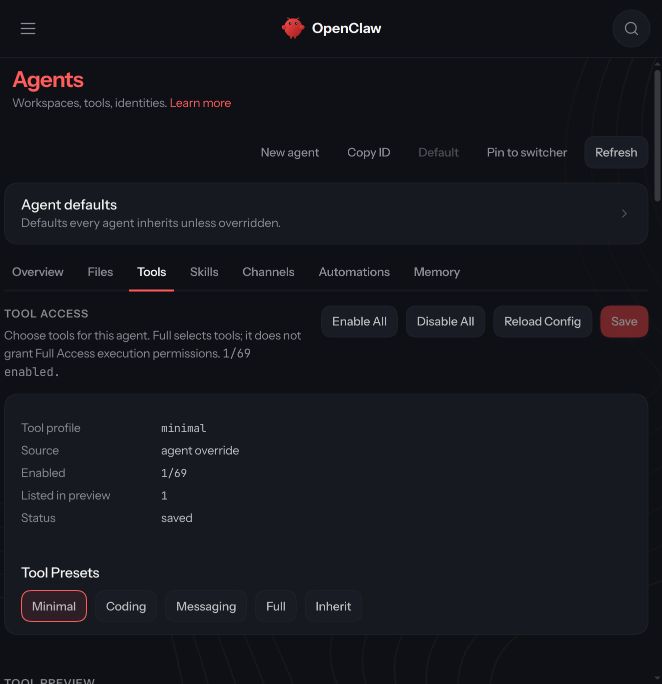
The application exposes fixed MCP tool sets by role and validates inputs before dispatch. Tasks, evidence and approval records live in application SQLite state; OpenClaw retains ownership of its native session state.
Task coordination
- Owner request
- OpenClaw Gateway and agent roles
- Role-scoped MCP tools and validation
- SQLite task registry, evidence and results
- Local status interfaces for review
Career approval path
- Source research and requirements
- Confirmed candidate facts
- Versioned application package
- Separate approval for the exact package
- Configured submission path and recorded outcome
Audit events record the role, tool and outcome without storing tool payloads. The coordinator receives minimal metadata about other roles’ tasks. Uncertain submission attempts block automatic replay.
These are application controls. They do not provide operating-system isolation or a guarantee against prompt injection. External content cannot grant new authority.
Review a proposal before applying a change.
Owner feedback and task-result metadata feed versioned memory and improvement proposals. Candidates retain their sources and content hashes; a fixed evaluator checks declarative career-policy proposals against synthetic baseline and holdout cases.
Passing checks makes a candidate ready for owner review. Approval is bound to its exact version, with application and withdrawal handled separately. The process does not train model weights or apply arbitrary code changes. Synthetic success does not establish better live results.
The public core and the private continuation.
The system continued to develop beyond the distilled release. In the private continuation, Code Brewing v4.2, I migrated the application to TypeScript, adapted it for continuous operation on Ubuntu Server, and expanded learning, monitoring, evaluation and decision-making mechanisms.
Extensive changes to the original OpenClaw architecture also led me to build a dedicated update pipeline to preserve custom modifications during upstream updates. Security work expanded to dependency and package audits, authorization controls, execution boundaries and sandboxing.
Public ai-system-4 edition
- Earlier prototype distilled into a smaller source snapshot
- Role-scoped MCP tools and shared SQLite workflow state
- Local interfaces, synthetic checks and architecture notes
- Incremental typing across a limited set of JavaScript modules
Private Code Brewing v4.2
- TypeScript migration and Ubuntu Server operation
- Expanded learning, monitoring and evaluation
- A dedicated upstream update pipeline
- Broader security and execution controls
The private-version summary reflects my development history. Those extensions and the private agent knowledge base are not included in ai-system-4; their runtime behavior is not demonstrated by the public source or these screenshots.
A working personal prototype with an inspectable source edition.
A personal prototype with task coordination, role-scoped tools, career preparation workflows, read-only mail review and local status interfaces. A sanitized source edition is available on GitHub. Real workflow quality, complete runtime setup from a clean clone and independent backup recovery remain open work.
The source edition includes synthetic workflow checks and incremental strict TypeScript checking for four JavaScript modules. These development checks do not verify live integrations. Some helpers retain Windows dependencies, and some OpenClaw adapters depend on version-specific internals.
The repository excludes credentials, databases, conversations, candidate materials and private workspaces. It is a source snapshot, not a backup of the working installation.